
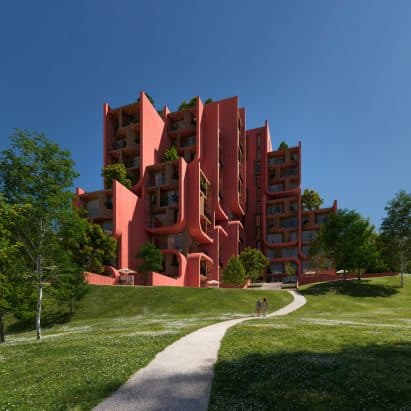
Zaha Hadid Architects Unveils 'The Nest': A Bold Residential Vision for Tirana, Albania
Zaha Hadid Architects (ZHA) has revealed an ambitious new residential project for the Albanian capital of Tirana, one that pushes the boundaries of conventional housing design through the imaginative use of overhanging balconies. Named The Nest, the development proposes a series of interconnected housing blocks whose visual identity is defined by dramatically cantilevered balcony structures that reach across the facades, drawing the separate volumes into a cohesive, unified whole. The project represents both a technical achievement and a philosophical statement about community, connectivity, and what contemporary urban housing can look like in a rapidly developing Eastern European city.
What Is 'The Nest' and Where Is It Located?
The Nest is a residential housing complex designed for Tirana, the capital and largest city of Albania. Over the past two decades, Tirana has undergone a remarkable urban transformation, with international architects and developers increasingly turning their attention to a city eager to redefine itself on the world stage. Against this backdrop, Zaha Hadid Architects — the globally renowned firm founded by the late Dame Zaha Hadid and now led by Patrik Schumacher — has proposed a development that responds directly to the character and ambition of a modernising Albanian metropolis.
The project takes its name, The Nest, from the interlocking, organic quality of its architecture. Much like a bird's nest is formed from individual elements woven together to create a single, resilient structure, The Nest uses its overhanging balconies and sinuous facades to bind multiple residential blocks into something that reads, from a distance, as one unified building complex. It is a fitting metaphor for a project that is as much about community and togetherness as it is about individual homes.
The Design Concept: How Overhanging Balconies Create Unity
At the heart of The Nest's design is the use of overhanging, cantilevered balconies as the primary architectural device for uniting what would otherwise be separate residential volumes. Rather than treating each housing block as a standalone element, ZHA has deployed balconies that extend outward and overlap with adjacent structures, creating a visual and spatial continuity across the entire development.
This approach is characteristic of Zaha Hadid Architects' broader design philosophy, which consistently favours fluid, dynamic forms over rigid, compartmentalised ones. The balconies are not merely functional outdoor spaces — though they certainly serve that purpose — but are active components of the building's compositional language. Their curvature, depth, and angle are carefully calibrated to create a sense of movement across the facade, as though the architecture is in a state of gentle, perpetual flow.
The result is a building complex that avoids the monotony often associated with large-scale residential developments. Where many housing blocks of a similar scale tend to feel repetitive or impersonal, The Nest uses the rhythm of its balconies to create visual interest at every level, giving each floor and each unit a distinct relationship to the exterior while still contributing to the overall harmony of the whole.
Architectural Language and Material Palette
ZHA's designs have always been distinguished by their commitment to material sophistication alongside formal innovation. The Nest continues this tradition, with renderings suggesting a palette of light-toned concrete and glass that allows the building's sculptural qualities to remain front and centre without the distraction of heavy ornamentation. The overhanging balconies, with their curved undersides and smooth profiles, catch light differently at various times of day, ensuring that the building's appearance shifts and evolves from morning to evening.
The glazed facades of the residential units are designed to maximise natural light penetration deep into each apartment, a practical consideration that also reinforces the development's sense of openness and transparency. The interplay between solid balcony soffits and glass walls creates a layered depth to the facade that rewards close inspection as much as distant viewing.
Housing Design in a Contemporary Context
The Nest arrives at a moment when the design of residential housing is under greater scrutiny than perhaps at any point in recent memory. Across Europe and beyond, architects, planners, and policymakers are grappling with how to deliver housing that is not only functional and affordable but also genuinely enriching to live in and to look at. The challenge is particularly acute in cities like Tirana, where rapid growth and development pressure can sometimes result in the prioritisation of quantity over quality.
ZHA's intervention with The Nest makes a clear argument that these two goals — delivering enough housing and delivering beautiful, thoughtfully designed housing — need not be in conflict. By applying the same level of design rigour to a residential block that the firm brings to its landmark cultural buildings, the project sets a standard for what aspirational urban housing can achieve.
Community and Connectivity
Beyond the formal qualities of the design, The Nest also reflects a growing emphasis in contemporary architecture on fostering community and social interaction within residential developments. The shared spaces created beneath and around the overhanging balconies — sheltered zones that are neither entirely inside nor fully outside — offer residents informal gathering places that encourage spontaneous encounter and neighbourly exchange. This blurring of the boundary between private and communal space is a hallmark of thoughtful housing design, and ZHA has built it directly into the architectural logic of the project.
Zaha Hadid Architects and Albania: A Growing Relationship
The Nest is the latest sign of a growing relationship between Zaha Hadid Architects and Albania. Tirana's ongoing urban renewal has attracted considerable international architectural interest, and ZHA's involvement signals the city's rising ambition to become a genuine destination for design excellence in Southeastern Europe.
The firm's track record in delivering complex, large-scale residential and mixed-use developments around the world makes it well placed to bring The Nest to fruition. From its OPUS mixed-use tower in Dubai to residential projects across Asia and Europe, ZHA has demonstrated a consistent ability to translate visionary concepts into buildable, liveable architecture that continues to attract attention long after completion.
Looking Ahead: The Future of The Nest
As The Nest moves through the development and approvals process, it will be closely watched by architects, urbanists, and housing advocates who see in it a potential model for residential design in rapidly growing cities. Its central proposition — that bold, inventive architecture can and should be applied to everyday housing, not just to museums or concert halls — is one that resonates far beyond Tirana.
If realised as designed, The Nest will stand as one of Zaha Hadid Architects' most compelling contributions to residential architecture: a project where overhanging balconies do far more than shade a terrace. They unite, define, and elevate an entire community.